– Critique of Hegel’s Philosophy of Right
Political Economy | Labour Geography | Technology | Social Reproduction
I am a PhD researcher at King’s College London funded with ESRC grant (through LISS-DTP), working on the political economy of domestic work, platformisation, and social reproduction in urban India. My research examines how digital platforms reorganise labour, reshape everyday life, and extend market relations to intimate and reproductive domains.
Alongside my academic work, I am engaged in labour activism in India, collaborating with workers’ organisations and unions to confront precarity and informality in the platform economy. These engagements inform my research and seek to situate contemporary transformations of work within broader questions of inequality, class, and social reproduction.

Explore
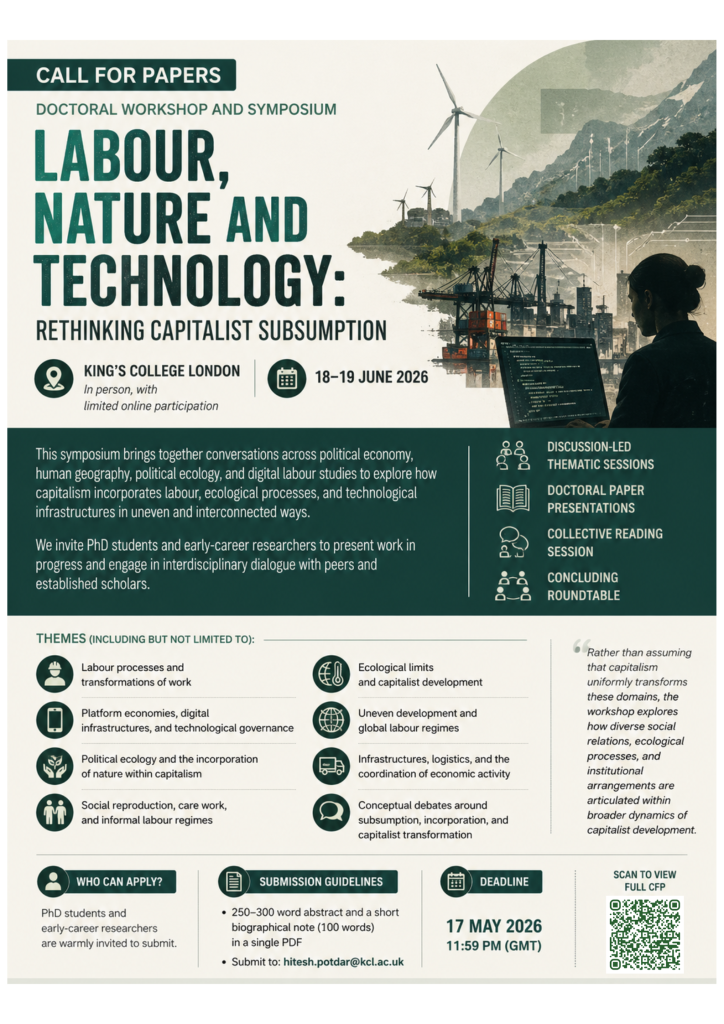
Doctoral Summer Symposium ‘Labour, Nature and Technology: Rethinking Capitalist Subsumption’ at King’s College London, 18th and 19th June, 2026
Recent scholarship across political economy, human geography, political ecology, and digital labour studies has increasingly examined how contemporary capitalism reorganises relations between work, ecological processes, and technological infrastructures. Yet these debates often develop in relative isolation. Research on labour has focused on transformations in labour processes and employment relations, while political ecology has explored the appropriation of nature within capitalist accumulation, and studies of digital capitalism have analysed the growing role of technological infrastructures—from platforms to artificial intelligence—in shaping economic activity.
This symposium seeks to bring these conversations into dialogue by exploring how capitalism incorporates heterogeneous domains of social and material life into circuits of accumulation. Drawing inspiration from recent debates around the concept of ‘subsumption’ (Banaji, 2010; Harootunian, 2015; Saenz De Sicilia, 2025; Tomba, 2013), the workshop approaches labour, nature, and technology as interconnected terrains through which capitalist incorporation unfolds unevenly. Rather than assuming that capitalism uniformly transforms these domains through technological innovation or industrialisation, the workshop explores how diverse social relations, ecological processes, and institutional arrangements are articulated within broader dynamics of capitalist development.
Ecological processes follow biological and environmental temporalities that cannot be fully synchronised with the abstract time of capital (Battistoni, 2025). Similarly, reproductive and informal labour often remain embedded in social relations that resist complete technological reorganisation (Baglioni, 2025; Baglioni et al., 2022; Mezzadri, 2021, 2025). At the same time, technological systems from digital platforms to algorithmic infrastructures seek to coordinate and govern these heterogeneous processes through new forms of measurement, mediation, and control (Briziarelli, 2024). Bringing these perspectives together raises broader questions about how labour processes, ecological systems, and technological infrastructures are articulated within contemporary capitalism and how these dynamics shape patterns of uneven development.
The symposium will combine thematic discussions with doctoral paper presentations, creating a space for PhD researchers to present work in progress and receive feedback from invited scholars and peers. The symposium will include a collaborative reading session at the conclusion of the first day and a roundtable discussion at the end of the workshop.
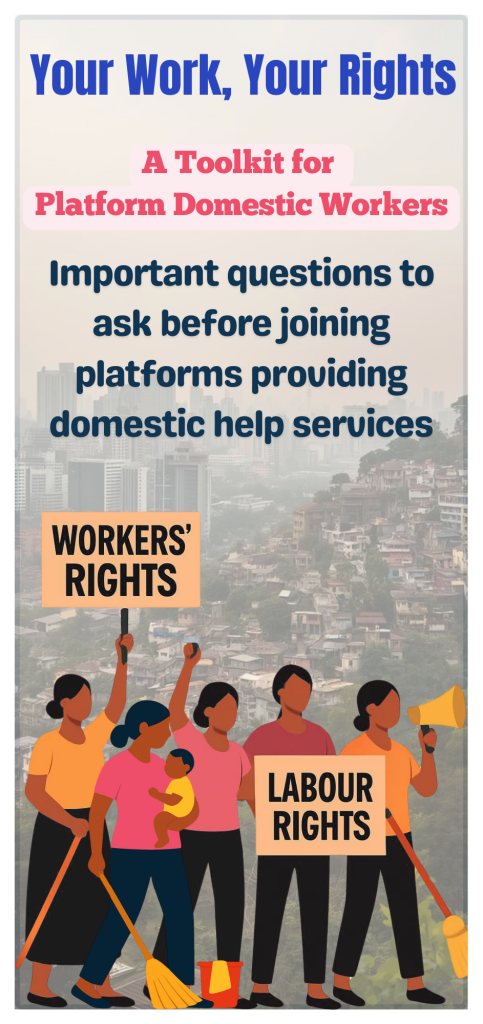
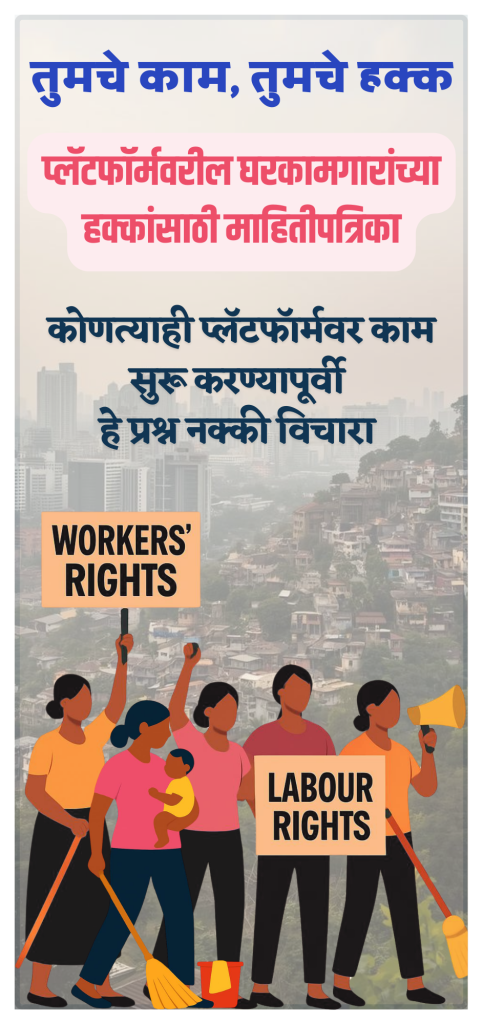
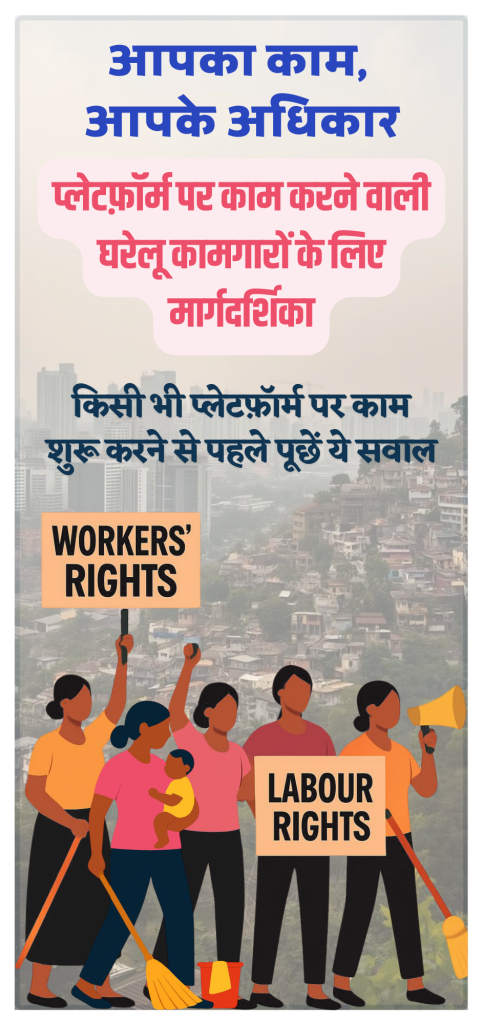
Your Work, Your Rights: A Toolkit for Platform Domestic Workers
Domestic work delivered through digital platforms is expanding rapidly across Indian cities. Yet many workers, especially women, often begin platform work without full clarity about wage deductions, rating systems, insurance coverage, or ID deactivation processes.
Over the past year, through field research and extended conversations with platform-based domestic workers, I repeatedly heard the same concern: critical information becomes clear only after work has already started. In response, I’ve put together a simple awareness toolkit containing key questions workers may wish to ask before joining a platform. The aim is not to target any specific company, but to encourage transparency, informed decision-making, and better bargaining at the point of entry.
This document is based on field research and worker conversations. It is intended for informational purposes only and does not constitute legal advice or imply endorsement of any particular platform. I hope it may be useful not only for workers, but also for unions, collectives, NGOs, researchers, and policymakers working on digital labour and domestic work.
The toolkit is free to use. Please feel free to translate, adapt, expand, or co-brand it for organisational use. I’m happy to collaborate.
Domestic work is skilled work. Transparency is respect.
If you have suggestions to improve or further sensitise the language, I would welcome your feedback.
Download it here: https://tinyurl.com/2745suvk

Categories