(The article was originally a paper I submitted to a course on ‘State and Democracy, taught by Prof Ashwini Kumar, during my MA at TISS, Mumbai)
‘Nations are not something eternal. They began, so they will come to an end’, said Ernest Renan in his celebrated article Qu’est-ce qu’une nation? (1882). In the contemporary period, the perversion of nationalism by stressing ethnic politics in India has damaged the post-colonial legacy of nationalism and is now considered a problem in the general academic discourse and the public as well. The problem of nationalism in India cannot be approached solely from the perspective of the indigenous development of nationality, in isolation, but rather from the perspective of European conceptualisation. Another hindrance we face is the multi-faceted and region-specific nature of the definition of nationalism. There is no widely recognised definition. There are differences over the term’s genesis, too. In Benedict Anderson’s words, ‘no one has been able to prove either its modernity or its antiquity decisively’. Thus, the study of nationalism necessarily and inevitably starts with the historical understanding of it. Carl J. Friedrich had once said that there was a need to distinguish between the ‘old’ nations of the West, which developed under ‘The Great Transformation’, and newly formed post-colonial nations, which were deliberate constructions. Therefore, our investigation should also start with theories of European Nationalism and later compare and differentiate them with those of India.
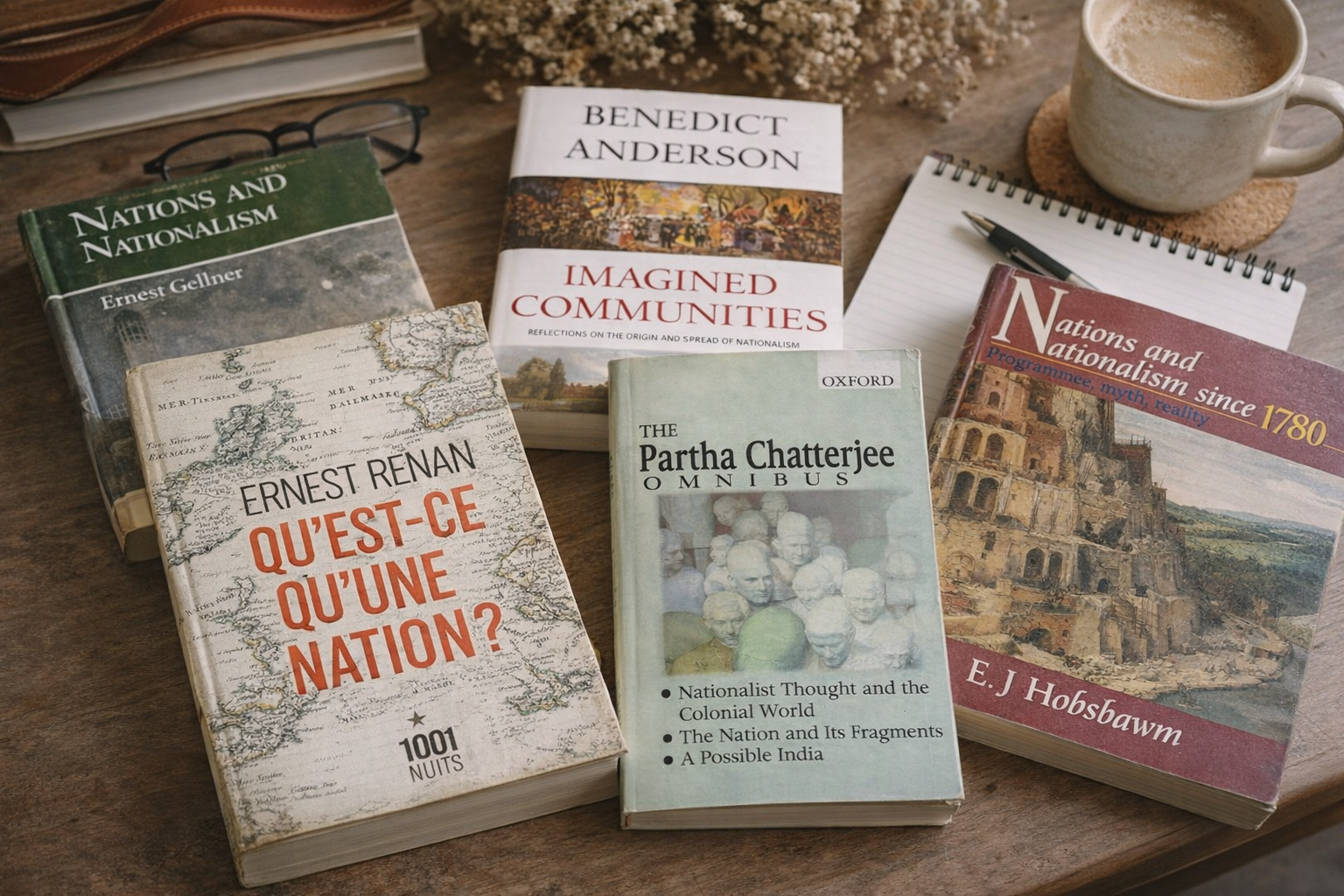
To have this comparative study, the paper presents three important European theorists of Nationalism- Ernest Gellner, who necessarily belongs to the liberal-rational school, Eric Hobsbawm and Benedict Anderson, both of them of the Marxist School (Hrosh and Smith among others) and Partha Chatterjee, as one of the prominent theorists of Indian Nationalism.
Following the discourses on the genesis and origin of the concept, we begin with Gellner, who finds the emergence of nationalism in the social transformations of the nineteenth century (Gellner, 1996). Indeed, not all propositions and theoretical projections are true in India. Yet, we could seek some historical traits which are identical to Indian situations. Gellner sees nationalism as ‘linking the state and the nationality defined culture’, a feature found in every nation’s conceptualisation. Further, he creates two models for micro-units evolving into nations, the process which proceeds in five stages. So, for Gellner, nation formation requires a peculiar structuration and standardisation of society that emerges in the epoch of Industrial society. First, he tries to describe the ‘agro-literate society’ which he finds not suitable or ripe for the emergence of nationality and/or nationalism. For him, a characteristic value of such a society is ‘nobility’, which means a conjunction of military vocation and ascribed ‘high status’ (Gellner, 1996). We cannot relate the Indian situation (specifically in the colonial period) to his conceptualisation, as the former was definitely an agro-society but not literate; yet we could see the emergence of ‘nationalism’ in pre-independent India, which will be discussed thoroughly later in this paper by referring to Partha Chatterjee’s argument, which links it with the literate-elites of India. There are two ways to maintain order in agrarian societies: coercion and consent (Gellner, 1996), a feature also evident in the feudal societies of India, especially the caste-system-driven feudalism. As relations of production and subsequent distribution also play a vital role in creating solidarity among people within a territory, caste-system-driven feudalism becomes crucial. Nonetheless, Gellner also says, ‘tools and techniques on their own cannot make men conform to the rules of distribution: this can only be done through either coercion or consent, or a fusion of both.’ This type of society relies not only on its differentiated agrarian structure but also on literacy. Whereas writing plays a crucial role in preserving, transmitting, and further accumulating data, ideas, affirmations, information, and principles. (Gellner, 1996). This leads to formation of ‘distinguished culture’ with the specified newly evolved ‘language’ which we take on the jobs and makes literacy as ‘badge of rank’ as well as constituting ‘a guild mystery’ (Gellner, 1996). The question arises whether Sanskrit and Brahminism played the same role in the creation of nationality, or whether something more is at work.
Dr B. R. Ambedkar also stressed the question of whether India is a nation or not, which has been the subject matter of controversy between the Anglo-Indian and the ‘Hindu Politicians’ ever since the Indian National Congress was founded (Ambedkar, 2017). However, Ambedkar implicitly directed it to the question of the caste system, which emerged when he told Gandhi- We do not have a motherland’. Nevertheless, in both cases, it defies Gellner’s propositions anyway, as Gellner does not consider the genesis of nationalism in such a society. Because he thinks that agrarian society engenders estates, castes, guilds, and status of all kinds, which require cultural expression.
The kind of ‘cultural homogeneity’ which causes the coming of nationalism, Gellner sees, in the ‘Advanced Industrial Society’. Gellner discerns two principles of legitimacy for social order: one, economic growth and two, nationality, which constitutes our theme. The industrial society, Gellner expects, which is structured and standardised, could hardly be organised on any base other than a national one (Gellner, 1996). This very society expects the same culture contextualised within the ambit of the State, where the nature of labour, which has become semantic, and work requires impersonal context-free communication between individuals, members of the broad mass. This can only be done if the members of that broad mass share the same rules for formulating and decoding messages. In other words, they must share the same culture. And it will be a high culture, for this standardised skill can only be acquired in formal schooling. This high culture is maintained by the state which plays crucial role and ‘can perform the task of quality control in this most important of all industries, that is the production of socially acceptable, industrially operational human beings (Gellner, 1996). Hence, we could say that nationalism means ‘a principle which holds that the political and national unit should be congruent (Gellner, Nations and Nationalism).
Taking Gellner’s theorisation further with two broader concepts: one, cultural homogeneity and two, semantic and/or language-based high culture coupled by economic growth; using these as tools to articulate Indian nationalism, we get two totally different premises. Considering cultural homogeneity in the premise of ethnicity, which basically comes from right-wing ideologues in its fullest form, and another premise is in terms of language, literature and/or overall education (in the context of Partha Chatterjee’s conceptualisation). As Anthony Smith puts it- ‘Nation is a named human population sharing a historic territory, common myths and historical memories, a mass, public culture, a common economy and common legal rights and duties of all members’ (Smith, 1991). Smith’s nationalism deals with the material of cultural identities and cultural nations; it is ‘a form of culture—an ideology, a language, a mythology, symbolism and consciousness—that has achieved global resonance and the nation is a type of identity whose meaning and priority is presupposed by this form of culture’ (Smith, 1991).
The first premise of ethnicity in cultural homogeneity has always been regressive in the Indian context, where we witness the imposition of a majoritarian perception of history, culture and language. In Ernest Renan’s words- ‘Forgetting history, or even getting history wrong, is an essential factor in the formation of a nation, which is why the progress of historical studies is often dangerous to a nationality’ (Renan, 1882). Unfortunately, the history that nationalists want is not the history that professional academic historians, even ideologically committed ones, ought to supply (Hobsbawm, 1996). In contemporary times, we have also been witnessing many versions of distorted history emerging from the ruling party to legitimise their rule under the guise of nationalism, sometimes even within the domain of the state and with its help. According to Hobsbawm, ‘nationalism is nothing but a political programme’ which encompasses territoriality, particular ethnicity and also language, which is taken, wherever possible, to express and symbolise ethnicity. For example, in India, right-wing Hindutva parties have always had a narrative of ‘Hindi, Hindu and Hindustan’. This political programme seeks to exercise supreme control over a stretch of territory with a homogeneous population, which serves as an essential body of citizens.
The second premise will inevitably take us to discuss Partha Chatterjee’s conceptualisation of nationalism in India. His works, ‘Nationalist Thought and the Colonial World: A Derivative Discourse?’ and ‘Whose Imagined Community?’, explicate and criticise the ‘sociologism’ of Gellner and Anderson as well. This approach defies all presumptions and teleological fallacies of Hindu-ethnic nationalism and describes Indian nationalism from a very different perspective. Chatterjee has used two analytical frameworks in formulations- one, ‘thematic’ and ‘problematic’ (Raju, 1993). For Chatterjee, Indian Nationalism is problematic here and considers general idea of nationalism as thematic and the relation between both is not simple, for him, Indian Nationalism is nothing but the derivative of general idea of nationalism i.e. European nationalism. He sees every idea of nationalism as a problem in the history of ideas itself by taking into account the knowledge/power axis, which sees ‘thought’ as dominating or subjugating. He sees nationalism as a Western idea, originating in the Enlightenment. The conception of rationality underlying the nationalist discourse is derived from the Enlightenment presuppositions of man and society, which we could find in the ‘social contract’ discourse. In this discourse, man has been shown forming and shaping a social state which eventually takes the form of ‘artificial society’ and hence the ‘general will’ can be viewed as forming the ideological basis for the idea of nationalism (Raju, 1993). This theorisation finds expression in Gellner’s work on the transformation from an agrarian to an industrial society. But Chatterjee sees these transformations as discontinuous, which makes the very European idea of nationalism a discontinuous discourse. Once upon a time, nationalism was considered one of Europe’s most magnificent gifts to the rest of the world, but later, Europe’s failure to manage its ethnic component had repercussions for post-colonial countries. Chatterjee says, ‘whether good variety or the bad, nationalism was entirely a product of the political history of Europe’.
Chatterjee begins the conceptualisation of Indian Nationalism with a critique of the theoretical tendency represented by Anderson, which certainly seeks to treat the phenomenon as part of the universal history of the modern world (Chatterjee, 1996). His most profound and central objection to Anderson is: if nationalism in third-world countries (which used to be colonies) has to choose its own imagined community, and that too using the ‘Modular Forms’ given by these European countries, what do they have left to choose? This question is crucial to the whole articulation of nation and nationality, not just in India but in every third-world country. For Chatterjee, such countries have always been ‘perpetual consumers of modernity’; even our imaginations must remain forever colonised. Anderson’s assumption that the ‘modular forms’ are used by all countries around the world, considered hasty by Chatterjee, for him, the nationalist imagination of these countries was not in using those modular forms but in deviating from them. To explain these, Chatterjee divides the world of social institutions into two domains responsible for the emergence of nationalism: the material (outer) and the spiritual (inner). Whereas the ‘material’ domain is concerned with the modular forms that have been used in the Western world and adopted and/or imposed on third-world countries. The spiritual domain is where these countries leave their ‘essential’ mark on their cultural identity. The greater the adoption or imitation of Western skills, the greater the need to preserve your own spiritual culture, and that’s where Indian Nationalist Movement leaders come into the scenario and try to articulate a ‘derivative’ version of nationalism (Chatterjee, 1996). Here, ‘derivative’ means the adoption of Western ideals, along with a heavy reliance on indigenous cultural ideas. This formula for Chatterjee is a fundamental feature of anti-colonial nationalisms in Asia and Africa. In his own words, ‘if the nation is an imagined community, then this is where it is brought into being’. That nation was already sovereign, even when states were still under colonial rule, due to the presence of the spiritual domain.
Indian nationalism is a blend of modernity, which is material and Western in nature, and indigeneity, shaped by bilingual elites in India. Bilingual in the sense of the English-speaking middle-class of colonial India, who were also strongly hesitant about the incorporation and maintenance of the culture of India, mostly in the form of languages. Chatterjee says, ‘Anderson is entirely correct in his suggestion that it is ‘print-capitalism’ which provides the new institutional space for the development of the modern ‘national’ language’. This spiritual domain lies beyond the state’s domain. This very acceptance of Western material progress and affirmation of India’s own spiritual domain lead to the demand for autonomy within the state itself. This act of demanding autonomy within the state domain, which of course was colonial, is based on ‘rule of colonial difference’. Ultimately, this leads to the breakdown of British benevolence and confirms its own form of nationalism.
To conclude, the conceptualisation of Indian nationalism itself poses questions about the historicity of colonial developments and accordingly relocates the politics associated with it, in the present and the past as well. This relocation keeps the pendulum oscillating, shifting our positions on the compromise of autonomy, and keeps nationality as subjective as possible.
References:
Gellner, E. (1996). The coming of Nationalism and Its Interpretations. In B. Anderson, Mapping the Nations (p. 98). London: Verso.
Ambedkar, B. R. (2017). Who constitutes nation? In S. I. Habib, Indian Nationalism: Essential Writings. New Delhi: Rupa.
Chatterjee, P. (1999). The Partha Chatterjee omnibus: Comprising Nationalist thought and the colonial world, The nation and its fragments, and A possible India. Oxford University Press.
Gellner, E. (1983). Nations and nationalism. London: Blackwell.
Smith, A. (1991). National Identity. Harmodsworth: Penguin.
Renan, E. (1882). What is Nation?
Hobsbawm, E. (1996). Ethnicity and Nationalism in Europe Today. In B. Anderson, Mapping the nations (p. 255). London: Verso.
A. Raghurama Raju. (1993). Problematising Nationalism. Economic and Political Weekly, 28(27/28), 1433–1438.